
Vivek Ramaswamy's Donors Got a Law. Ohio Renters Got Higher Electric Bills.
Campaign filings trace a direct line from corporate landlord donations to the recent legislative rejection of tenant utility protections.
06/15/2026, written by Terra Goodnight
In April, the Ohio Supreme Court unanimously ruled that submetering companies, which buy electricity in bulk and resell it to apartment tenants for a profit, should be regulated as public utilities. Last week, Ohio lawmakers hurriedly passed HB 173, effectively overturning that decision.
Days before lawmakers advanced the bill, executives with financial interests in the submetering industry wrote tens of thousands of dollars in campaign checks to Vivek Ramaswamy and key Republican lawmakers.
According to campaign finance filings, Ramaswamy has received more than $58,000 from individuals with direct financial interests in Ohio’s submetering industry, which profits by billing apartment tenants for utilities through privately owned middleman companies.
The most striking example is Michael DeAscentis II, who has built a lucrative arrangement in which he is CEO of Lifestyle Communities, one of Columbus’s largest apartment developers, but also founder and CEO of Nationwide Energy Partners, the utility middleman that bills those same tenants for electricity. On June 5, DeAscentis contributed to both Ramaswamy’s gubernatorial campaign and House Speaker Matt Huffman. His wife Melanie matched his contribution to Ramaswamy. Three days later, another check went to Senator Shane Wilkin, chair of the Senate Public Utilities Committee that controlled the fate of HB 173. In four days, the DeAscentis household wrote $51,615 in campaign checks.
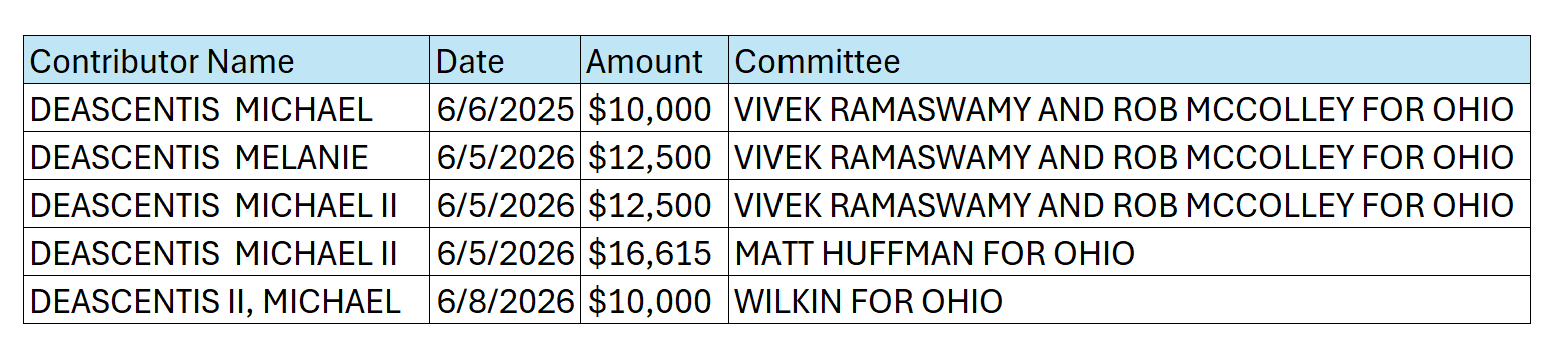
Two days after that last contribution, Wilkin’s committee reported out the industry-friendly rewrite of HB 173. The full Senate passed it the same day. The House concurred hours later.
DeAscentis wasn’t alone. Rowland “Tré” Giller III, who runs both Metro Development, a Columbus real estate empire, and APL/CCOS, the submetering company that bills his tenants for electricity, gave $20,000 with his wife to the Ramaswamy-McColley campaign in 2025 and personally testified before the Senate committee in support of the bill. Michelle Yeager, President of Champion Companies, another multifamily developer that testified for HB 173, gave $2,500 in 2025. Eric Wagenbrenner of Thrive Companies, a third developer that testified for the bill, gave $500.
Within days of the DeAscentis donations and on the second to last day of the legislative session before lawmakers break for the summer, both chambers of the Ohio legislature rushed through an industry-friendly rewrite of HB 173 that effectively overturned a unanimous Ohio Supreme Court ruling requiring submetering companies to be regulated as public utilities. The bill now awaits Governor Mike DeWine’s signature. UPDATE 06/26 - DeWine vetoed it.
Why does this matter?
If you rent an apartment in a large Ohio complex, particularly a newer one, there’s a good chance your landlord is making money off your electric bill, and you’ve never noticed. It’s called submetering. Instead of getting your electricity bill directly from your local utility, your landlord hires a middleman company to handle it. That company buys electricity in bulk at the cheap commercial rate, installs individual meters throughout the building, and then bills each tenant separately at the higher residential rate. And they keep the difference.
Lifestyle Communities is one of the largest corporate landlords in central Ohio. Their tenants get billed for their electricity through Nationwide Energy Partners, but they’re essentially the same organization. Both companies share the same CEO, Michael DeAscentis II. While submetering is illegal in most other states, it has been completely unregulated in Ohio for decades.
The Cost to Renters
This setup comes at a hefty price for tenants. A 2013 Columbus Dispatch investigation found that Nationwide Energy Partners routinely marks up electricity costs, charging tenants 5% to 40% more than the regulated utility price, often with little to no prior disclosure.
One renter of a Columbus 1-bedroom apartment complained on Reddit this month that “NEP submetering electricity bills are ridiculous (normally ~$350, spiking to $600 in winter).” Complaints like these are common.
Over the years, frustrated renters have filed dozens of complaints with the Public Utilities Commission of Ohio (PUCO). However, the PUCO, run by appointees of Governor Mike DeWine, declined to act. This year’s Supreme Court ruling made clear that they must. Now, at the urging of large corporate landlords who profit from marking up their tenants’ electric bills, legislative leaders have passed HB 173 to completely reverse that decision.
Bottom Line
While a Columbus renter of a small apartment faces the reality of a $600 winter electric bill, submetering executives have quietly poured more than $58,000 into Vivek Ramaswamy and Rob McColley’s campaign coffers since 2025 to secure political influence. When the Supreme Court threatened those profits in April, the industry doubled down, hiring an army of lobbyists and writing over $51,000 in emergency checks to key Republican leaders and the party’s gubernatorial nominee in a single four-day blitz. Days later, lawmakers responded by passing HB 173. By allowing campaign cash to override a unanimous Supreme Court decision, Ohio leaders have left vulnerable renters out in the cold. The bill now sits on Governor Mike DeWine’s desk, leaving it up to him whether to protect his constituents or the landlords that profit by marking up their utilities.